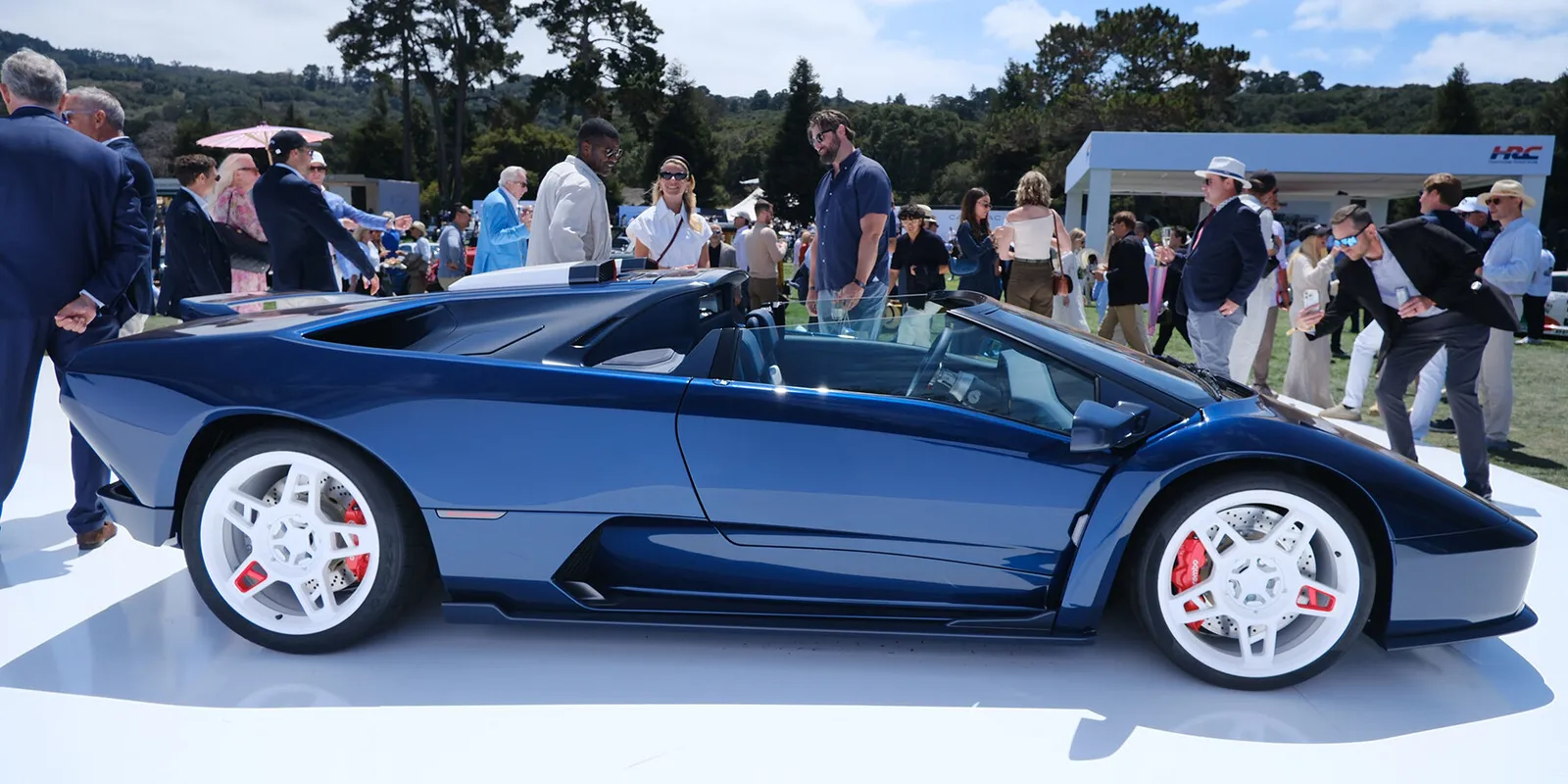
No Roof, No Turbos, No Screens: Eccentrica's Diablo Roadster and the Case for the Analog Restomod
The open-top V12 Roadster debuted at The Quail with a 550-hp V12, a gated six-speed and a former Lamborghini technical chief behind the engineering. Only 19 will be built.
There is a specific kind of person who sees a first-series Lamborghini Diablo and thinks it needs fixing. Eccentrica is built for those people. A couple of years ago, Jalopnik noted, the company announced the V12, a Diablo restomod with carbon bodywork, LED lighting, a modern interior and a gated manual, and promised 19 of them. On Aug. 14, it rolled out the follow-up at The Quail during Monterey Car Week: the V12 Roadster, a Diablo with the roof taken off and, by the company's count, more than 3,500 bespoke components underneath.
It is a fascinating car for reasons that go beyond its price tag. In an era when the restomod business is chasing more power, more screens and more assistance, Eccentrica is selling the opposite. No turbos. No automatic. Now, no roof.
The car it started as
It helps to remember what the Diablo was. It went on sale in January 1990, according to Wikipedia's history of the car, with a 5.7-liter V12 making 485 horsepower and a claimed top speed of 202 mph, which made it the first production Lamborghini rated beyond 200 mph. Marcello Gandini did the original design, but Chrysler, which had bought Lamborghini in 1987 and funded the car's development, disliked it, and its own styling team in Detroit produced the smoother final version.
Lamborghini built 2,903 Diablos between 1990 and 2001. An open VT Roadster joined the lineup in December 1995, after a roadster concept appeared at the 1992 Geneva show. So a topless Diablo is not a new idea. What Eccentrica is doing is building one from the first-series car, which never came as a roadster, and pushing the old V12 to 550 horsepower while keeping a clutch pedal and a gate.
That is why the numbers matter less than the feel. A modern Lamborghini makes far more power, with all-wheel drive, paddles and a stack of software. The Eccentrica keeps the original recipe, rear-drive, naturally aspirated and manual, and simply tries to make it better at everything it already did.
What Eccentrica actually did
 View full photo
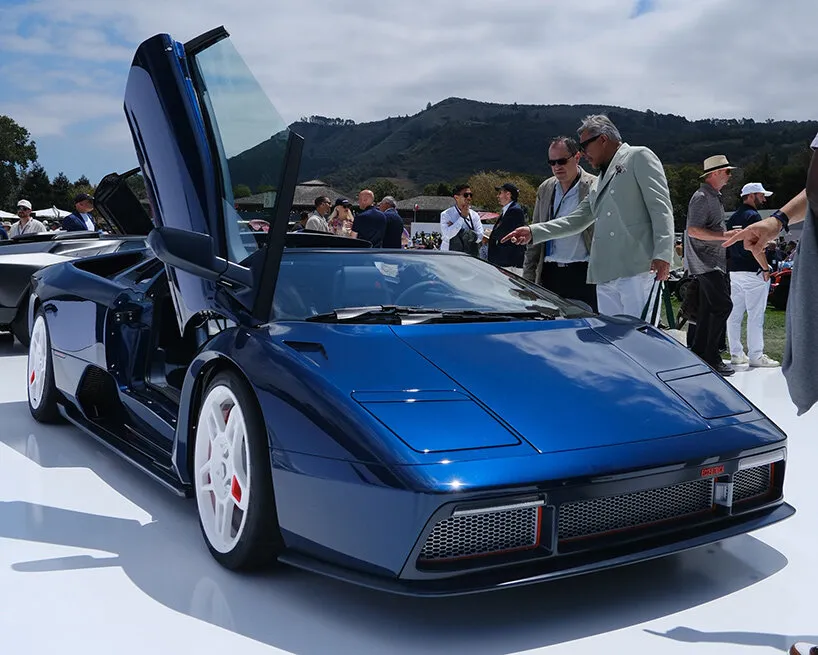
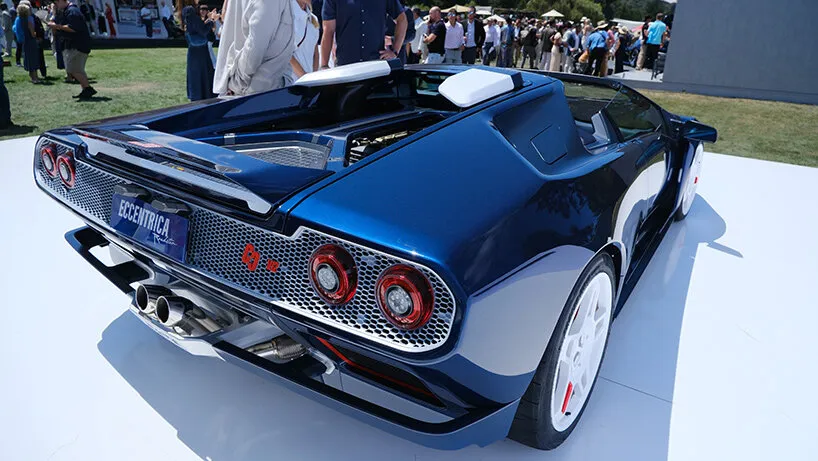
Start with the engine, because it is the reason the car exists. The Diablo's 5.7-liter naturally aspirated V12 stays, re-engineered and recalibrated for sharper throttle response and better thermal and airflow management, designboom reported from The Quail. It makes 550 horsepower at 7,000 rpm and 600 Nm, or 443 lb-ft, of torque at 6,500 rpm. Power goes through a six-speed manual with an open metal gate. Eccentrica claims a top speed of 208 mph, and Jalopnik reported a 0 to 60 mph time under 3.8 seconds.
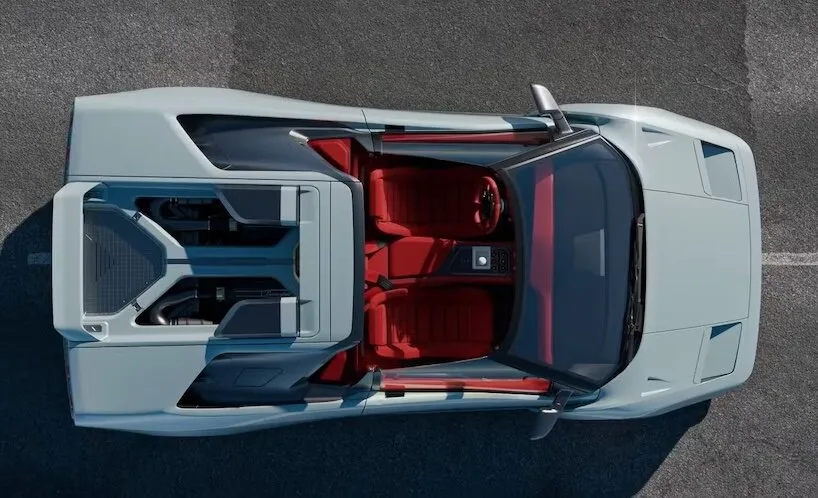
The roof did not just come off. Designboom reported that Eccentrica reworked the structure around the open cabin, with carbon fiber reinforcements to make up for the missing roof, a body that mixes steel and carbon fiber, a dedicated aerodynamic study for airflow around the exposed cockpit, a wider track, revised suspension geometry and a custom semi-active damper system. Steering stays hydraulic. The brakes are a modern Brembo system. Three drive modes adjust the car for different roads.
 View full photo
The people behind it
The engineering program is led by Maurizio Reggiani, the former Lamborghini chief technical officer whose resume includes the Murciélago, Gallardo, Aventador and Huracán, according to designboom. That is a big name to put behind a restomod. It also explains the car's priorities. Designboom reported that Reggiani's team focused as much on feedback as outright numbers, modifying the suspension, steering, brakes and chassis to make the car feel more immediate.
The design was done with Milan studio Borromeo De Silva, and the company's founder is Emanuel Colombini, per designboom. Eccentrica's stated obsession is what it calls analogue emotion, the idea that sounds, vibrations and mechanical inputs are the point of a car like this rather than flaws to filter out.
Inside the cabin
 View full photo
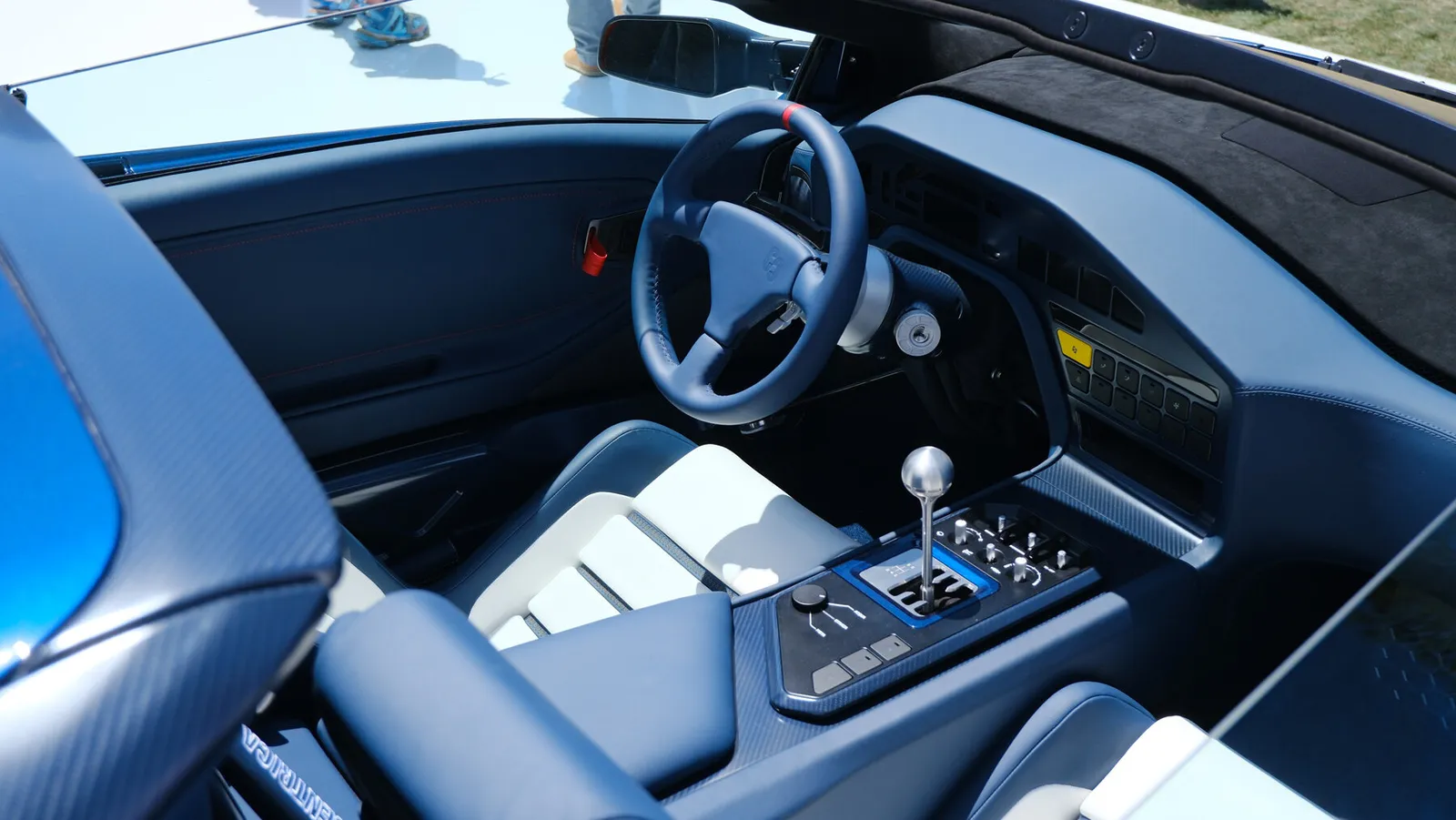
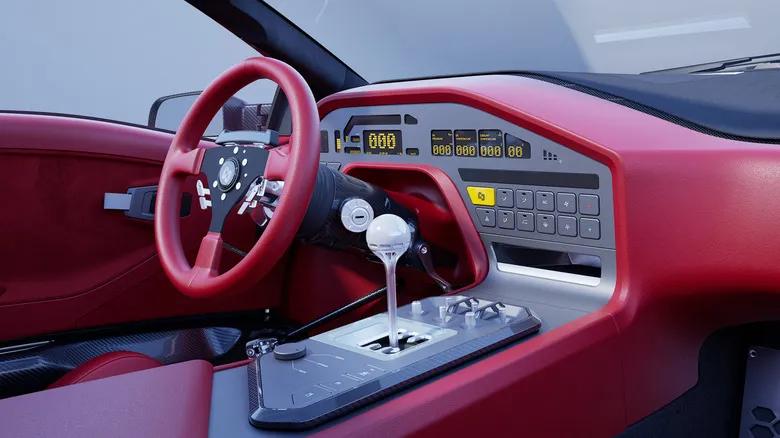
Every Roadster is configured with its buyer, designboom reported, down to colors, trims and materials. The interior mixes Connolly leather, Alcantara, anodized metal and exposed carbon. The renders Eccentrica released show a red cabin with a chunky steering wheel, a digital-style instrument panel and the gated shifter front and center. The car shown at The Quail wore dark blue paint with white wheels and a blue interior.
Jalopnik's Collin Woodard was not entirely sold. He noted that the cabin is largely carried over from the coupe, which Jalopnik had not loved, and that moving what appears to be the drive-mode selector to the center console only added to what he called the uncanny valley effect. He also pointed out that the steering wheel has no airbag.
The uncanny valley question
 View full photo
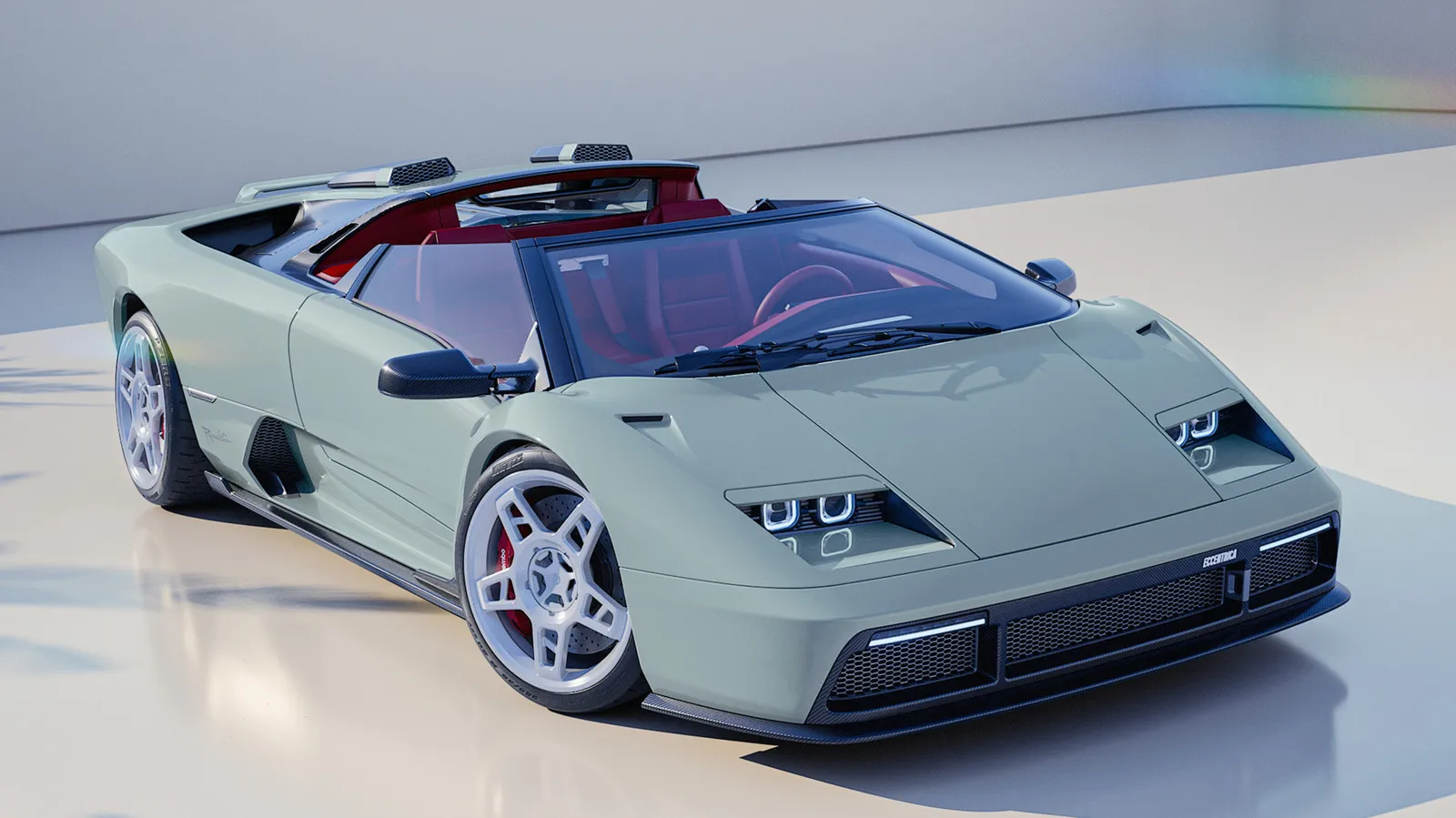
That phrase, uncanny valley, has followed Eccentrica since the coupe. Jalopnik's headline used it, and Woodard's specific complaints are fair. The carbon panels, he wrote, generally stay faithful to the Diablo's original lines even with the wider track and updated proportions. But the wheels do not look quite right, and with the pop-up headlights down and the round LEDs lit, the front end looks sleepy.
Here is the thing, though. The original Diablo was never a subtle or tidy design. It was a 1990s wedge that looked like it had been drawn by someone trying to scare the Countach. Any restomod of it is going to look slightly wrong to someone, because the reference point is so strong and so strange. Eccentrica is making changes to proportions that people have had burned into their memories since they had a poster on the wall. That is always going to be a fight.
The price of analog
 View full photo
Eccentrica did not publish a price for the Roadster. Jalopnik reported that the coupe was priced around $1.3 million, not including a donor Diablo, which it estimated at roughly another $400,000. It is hard to imagine the open car costing less, and Woodard put the likely all-in figure at something like $2 million.
That number tells you who the car is for. It is a collector piece, and Woodard openly doubted many owners would put real miles on one. But it also tells you something about where the high end of the restomod world is going. Restomods of 1990s supercars are arriving, and the selling point is not that they are faster than a new car. It is that they feel like a car from before cars were run by software.
Why it matters to the scene
 View full photo
Most of us will never sit in one. But the Eccentrica Roadster is a useful marker. When a former Lamborghini CTO signs on to re-engineer a 30-year-old Diablo with hydraulic steering and a gated manual, it confirms what a lot of enthusiasts already believe: the analog driving experience is now a luxury good. The same instinct drives a guy putting a manual swap into a modern truck or keeping an old hydraulic rack in a time attack car. It just looks different at $2 million.
Only 19 will be built. If even a few of them get driven with the roof down and the V12 near its 7,000 rpm peak, the point will have been made.
Sources
This story is compiled from the published sources listed below.

Written by
Devin B.
Founder
Devin founded TORQFOLIO to cover the whole aftermarket scene, from hot rods and LS swaps to donks, drift and Baja. Based in Las Vegas and usually at a show or meet with a camera.
More from Devin B.TORQFOLIO Weekly
The best of the week in cars, builds & culture. Every Sunday.
Keep Reading
The GTI Turns 50 and Goes Electric: Can a Battery-Powered Polo Carry the Badge That Invented the Hot Hatch?
Devin B.,
Not Every C10 Needs an LS: The Blacked-Out, Bagged 1969 Chevy That Kept Its Small-Block
Devin B.,
Restomod vs Restoration: How Each Is Judged, Valued and Insured
Devin B.,
Game Over: S-Klub LA Rebodied a New McLaren 750S as a Mercedes CLK GTR
Devin B.,
Conversation 0 comments
No comments yet. Start the conversation.