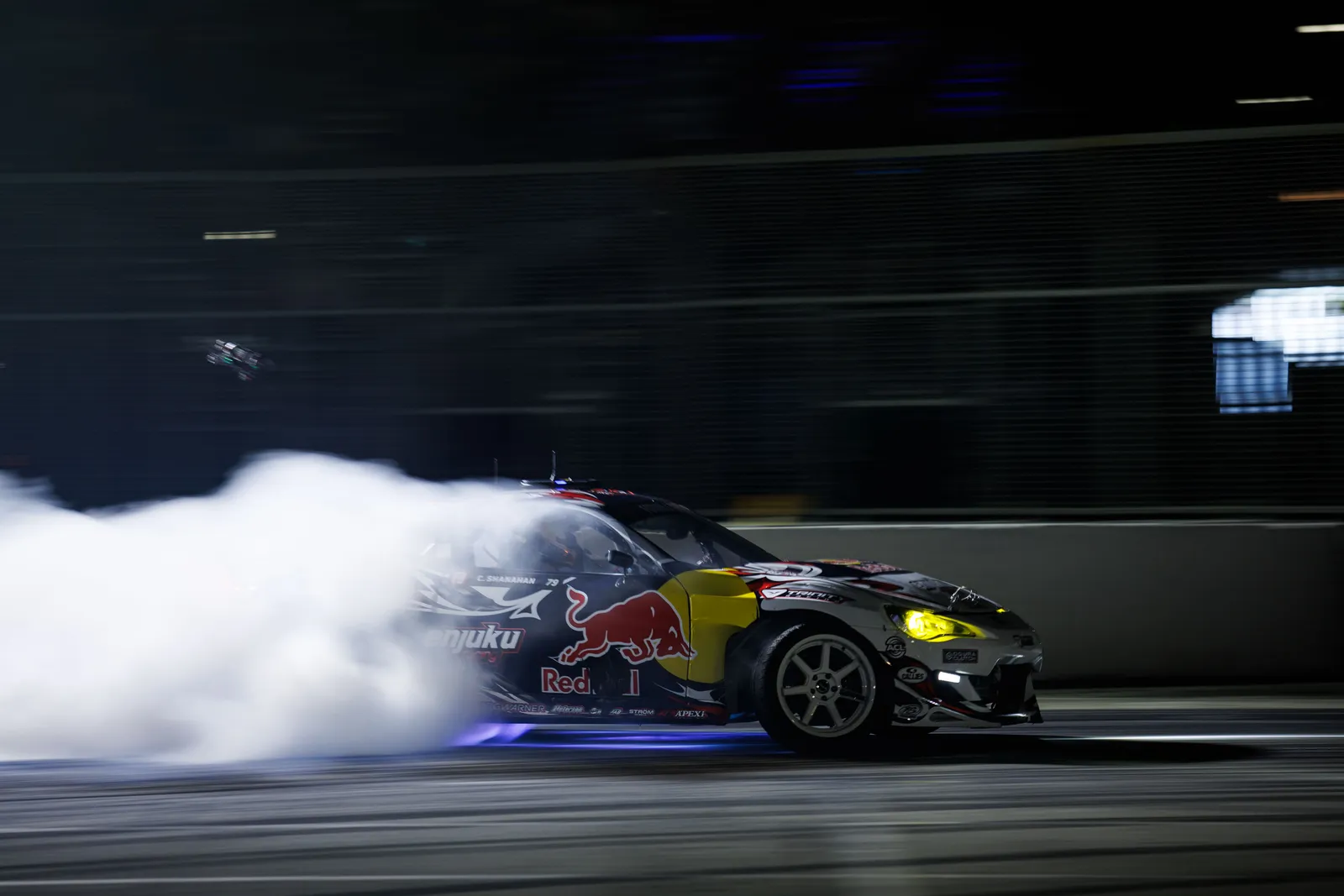
Free Engines, a Box on the Roof and a Tire Chart: The Rules That Built a 2026 Formula DRIFT PRO Car
Formula DRIFT lets teams swap any engine into any chassis. Almost everything else, from subframe heights to the hydraulic handbrake to a telemetry box that now scores qualifying, is spelled out to the fraction of an inch.
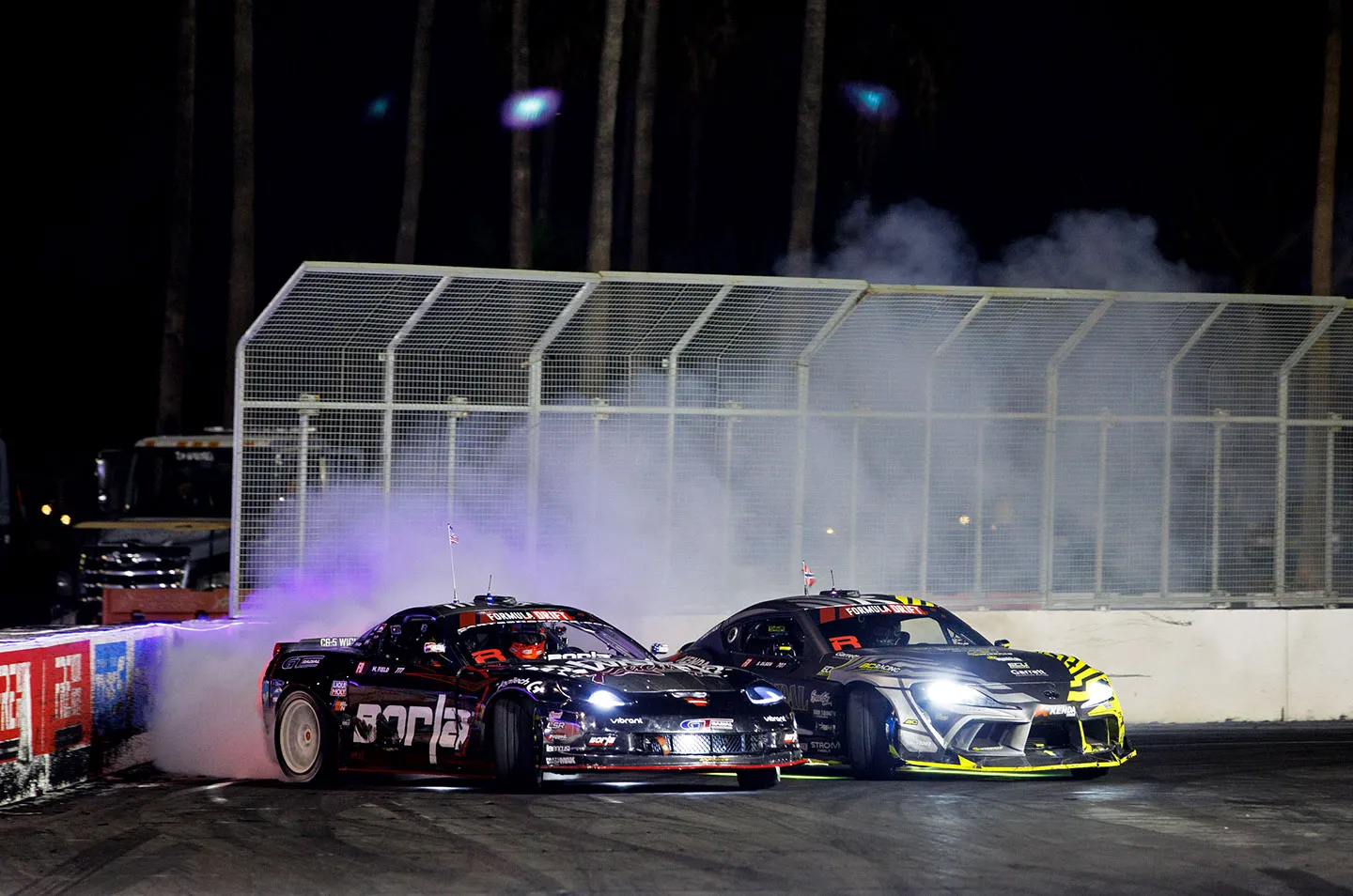
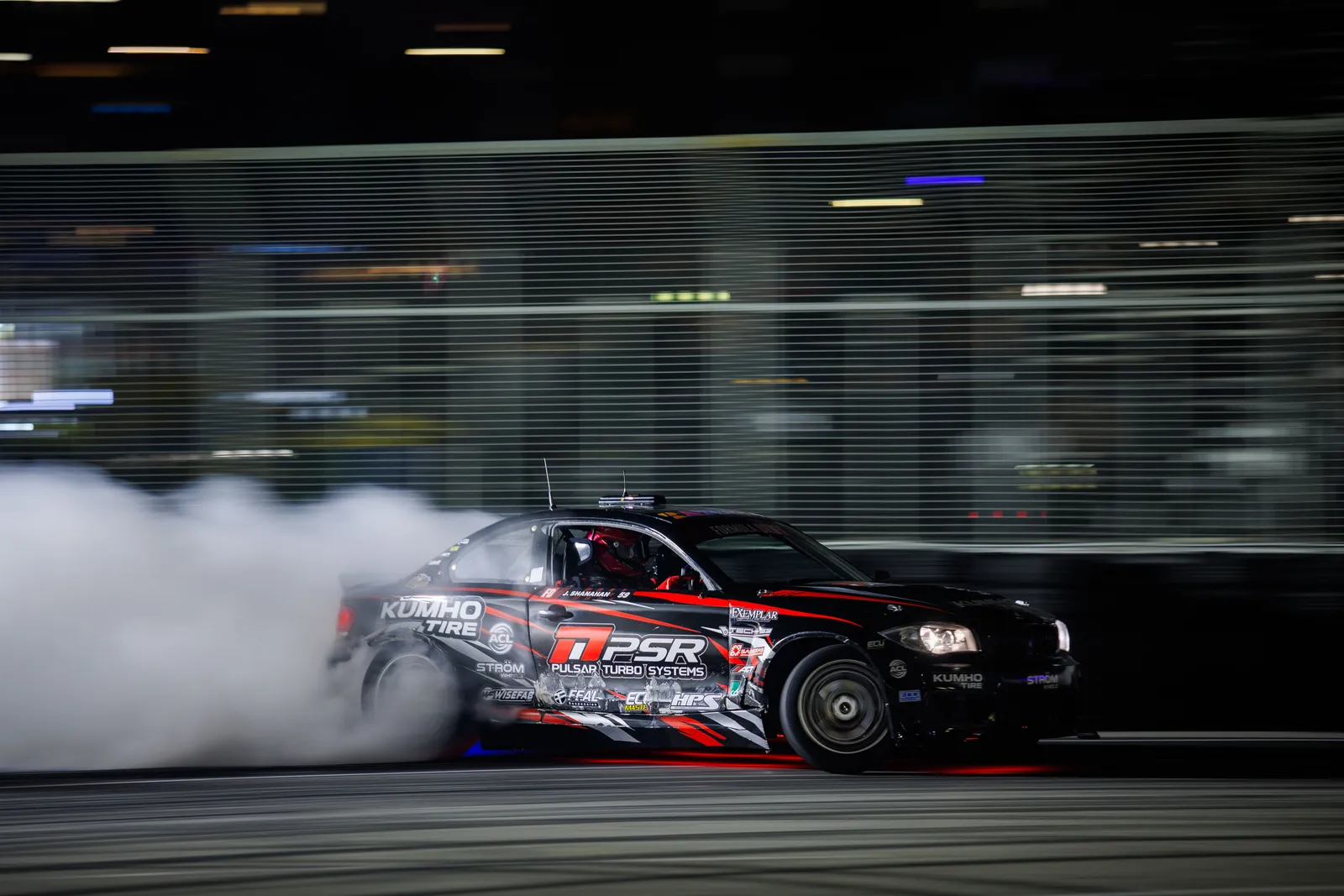
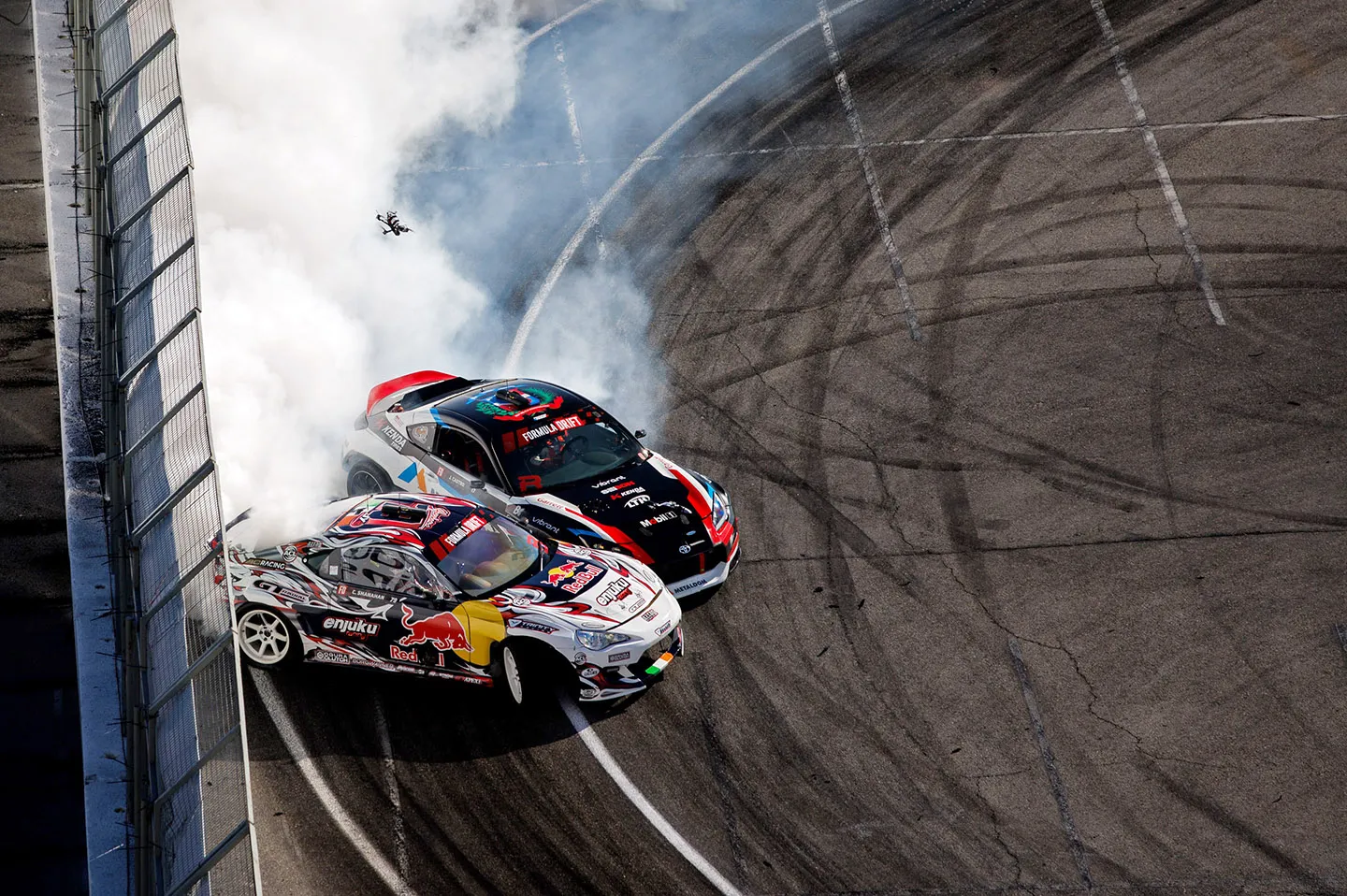
Conor Shanahan won the 2026 Formula DRIFT PRO championship in a Toyota GT86. James Deane, six points behind him, did it in a Mustang. The top qualifier at the Long Beach finale, Jack Shanahan, drove a BMW E82. A Japanese coupe, an American pony car and a German compact coupe, all running under one rulebook. That rulebook is the most interesting document in American drifting, because it is far more specific about what you cannot touch than about what goes under the hood.
Formula DRIFT publishes its 2026 PRO Technical Regulations as a 55-page PDF, version 1.1. Read it with the season over and a pattern jumps out. The engine is close to a free-for-all. The suspension mounting points, the subframes, the brakes, the tires and now the data stream are locked down hard. That split explains why a pro drift car looks the way it does.
The engine section is one paragraph
The heart of the rule is short: engine substitutions and modifications are free. The limits are about fuel, not hardware. Cars may run gasoline, diesel or ethanol blends, and methanol blends are banned. Electric and hybrid power is eligible, but only with prior written approval from the competition director. Drive-by-wire throttles are legal, with a catch: teams have to hand over ECU and PDM data logs for every official practice and competition session, and failing to do so can cost them up to all of their points.
That freedom is why the paddock is a swap meet. Any engine can go in any car, which is how a GT86 ends up fighting Mustangs and Corvettes for a title. The real engine limit is physical. No part of the engine casing may cross the vertical plane of the original firewall into the transmission tunnel, and firewall and tunnel modifications are capped by dimensions in the rulebook and must be made from .036-inch steel or .050-inch aluminum. You can swap anything, but you cannot shove it back toward the driver to fix weight balance.
 View full photo
Electronics get the opposite treatment. Traction control, torque management and other unspecified driver aids are banned, and the rulebook says wheel speed and driveshaft sensors must be removed. Paddle shifters are prohibited too: every shift has to be a function of the driver, done manually. Some ECUs must also run Formula DRIFT specific firmware, a requirement that dates to 2022.
Angle kits are free. Moving the mounting points is not
Steering is where the rulebook gets generous again. Modifications of steering components, including the rack and tie rods, are free, and that explicitly includes mounting the rack to the front subframe. That sentence is what makes the big-angle knuckle and arm kits the whole sport runs on legal in PRO.
The front suspension rules box that freedom in. The OEM front subframe and crossmember have to be stock and correct for the exact year, make and model being run. The original design type stays: a double wishbone car stays double wishbone, a strut car stays strut. Aftermarket arms and hubs are allowed, but relocation brackets that move a pivot point are not, bolt-in or not. The front subframe can only be cut for oil pan and starter clearance and for steering rack relocation, and it has to keep at least one major member spanning its full width.
Independent rear suspension follows the same logic. An aftermarket hub and arm setup must keep the factory link count, so a five-link car stays a five-link car. The rear subframe has to sit at a specified height, and the rulebook lists it chassis by chassis. An S13, S14 or S15 Silvia gets 0.675 inch at the front mounts and 0.600 inch at the rear. A GR86, GT86, BRZ or FR-S gets 0.445 and 0.335. The tolerance is .060 inch.
 View full photo
Two more lines matter on a drift car. In-cockpit adjustable suspension is banned, sway bars and electronic damper adjusters included, and no suspension changes are allowed between runs by any means, including remotely. Air jacks are prohibited during competition and competition time outs.
The hydraulic handbrake, in writing
Every grassroots drifter knows the hydraulic handbrake. The PRO rulebook spells out how it has to work. The primary brake system must hydraulically operate all four wheels, and a single, non-tandem master cylinder running all four is banned. Bias can be split front to rear only, never side to side, and driver-adjustable bias is allowed. A secondary hydraulic e-brake is legal as a fully separate system or as a pass-through system, but it may only operate the rear wheels.
Carbon, carbon ceramic and other carbon-variant brakes or rotors are not allowed. Brake lights must work with only the master cutoff switched on, and the rear brake light strip, which must stay 36 inches long, has to be wired into the existing brake light circuit and mounted on a fixed panel where it is visible from behind. In a sport judged partly on braking, the guy chasing needs to see it.
 View full photo
Weight buys tire
The tire rules are where Formula DRIFT balances power against grip without touching the engine. Every competition tire must carry a UTQG rating of at least 200, rear tires must be rated for an 18-inch wheel, and only tires on the approved list from the series tire partners are eligible. Then comes the table: the heavier the car, the wider the rear tire it may run.
The car is weighed track-ready with the driver aboard and registered to a class, and it can never weigh less than that class minimum. Tire width is measured across the contact patch with the official Formula DRIFT tool, on the rim, on the car, with the car on the ground, regardless of what the sidewall says. Teams can add up to 50 pounds of ballast, and weight-shifting devices of any kind are banned. It is a simple trade: bring more horsepower and you will probably want more rubber, which means carrying more weight.
The box on the roof
The newest hardware on a 2026 PRO car is not the engine. It is a telemetry device mounted dead center on the roof, 5.5 inches wide and 17.5 inches long, with a 24-inch perimeter around it that has to stay clear of cameras, sensors and antennas. Convertibles have to call the series for a solution. Every car also has to carry a 4-pin DTM connector at the passenger-side A-pillar, wired for CAN and 12-volt power that can support a 5-amp load, a data rule that has been in place since 2020.
That box feeds UDSM, the Universal Drift Scoring Method from Race Data Labs, which debuted at the 2026 opening round. As PASMAG reported when the change was announced in February, about 80 percent of a PRO driver's qualifying score now comes from the system, which measures drift line and car angle. The remaining 20 percent, for style, is still scored by the three-judge panel. Over the weekend the data also gives judges proximity between cars, comparative angle and speed, deceleration patterns including through tire smoke, and off-course detection down to individual wheel placement.
We're finally able to give our judges the tools they've been asking for.
Race Data Labs' Michael Vernuccio said the company's role would extend beyond traditional drift telemetry "to help evolve the sport into a new era of digital judging," per PASMAG. Formula DRIFT's own qualifying report from the Long Beach finale repeats the split: up to 80 percent of each qualifying score for line and angle from UDSM, 20 percent for style from the judges.
What the rules produced
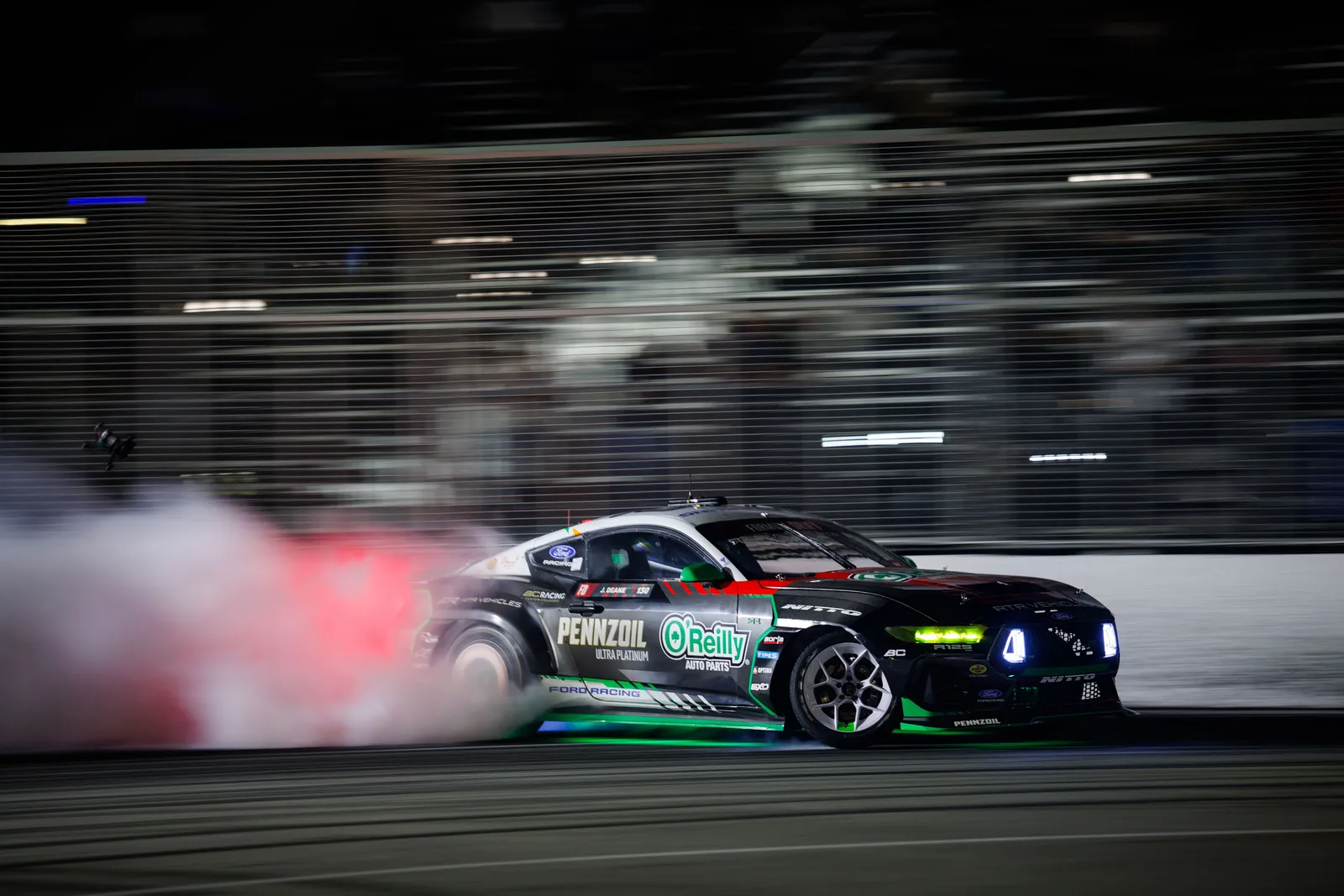
The season those rules framed went to the wire. Conor Shanahan arrived at Long Beach with a 47-point lead over Deane, qualified third and won the title 224 to 218 in the Red Bull, GT Radial and JYR GT86, according to Formula DRIFT. Deane won the final round in his Mustang, beating Jack Shanahan, who had topped qualifying in the Pulsar Turbos E82 BMW and spun in the final while chasing him.
 View full photo
"This was easily the hardest and most tide-turning season in our 23 years," Formula DRIFT president Ryan Sage said in the series wrap-up. With the engine bay left open, the fight happened everywhere else: inside the suspension geometry the rules allow, inside the tire width a car's weight buys, and now inside a scoring system that reads angle and line straight off the roof.
Sources
This story is compiled from the published sources listed below.
- 2026 Formula DRIFT PRO Technical Regulations, Version 1.1, Formula DRIFT
- Formula DRIFT Announces Major 2026 Competition Format Changes for 2026 Season, PASMAG
- Formula DRIFT PRO Championship Qualifying Results From Final Round 8 in Long Beach, Formula DRIFT
- Conor Shanahan Is the 2026 Formula DRIFT PRO Champion, Deane Wins the Final Round 8 in Long Beach, Formula DRIFT

Written by
Devin B.
Founder
Devin founded TORQFOLIO to cover the whole aftermarket scene, from hot rods and LS swaps to donks, drift and Baja. Based in Las Vegas and usually at a show or meet with a camera.
More from Devin B.TORQFOLIO Weekly
The best of the week in cars, builds & culture. Every Sunday.
Keep Reading
Ten Years in the Making: Paweł Korpuliński Wins Drift Masters in Front of 55,000 at Home
Devin B.,
GReddy's Supreme SP Cat-Back for the GR86 and BRZ Keeps the Factory Cat and Bumper Cutouts
Devin B.,
Heatwarped Is an Indie Love Letter to NFS Underground, Right Down to the Motion Blur
Devin B.,
Mag Blue Joins the TE37 SAGA S-Plus 30th Anniversary, in 17 to 20 Inches
Devin B.,
Conversation 0 comments
No comments yet. Start the conversation.