VMP's Leviathan Intake Helps a ProCharged Godzilla Make 1,771 HP on Pump E85
FordMuscle reported Brian Wolfe's engine dyno test of VMP's new air-to-water intercooled intake for Ford's 7.3-liter V8. The headline number is power. The useful number is 170 degrees of intake air temperature that never reached the cylinders.
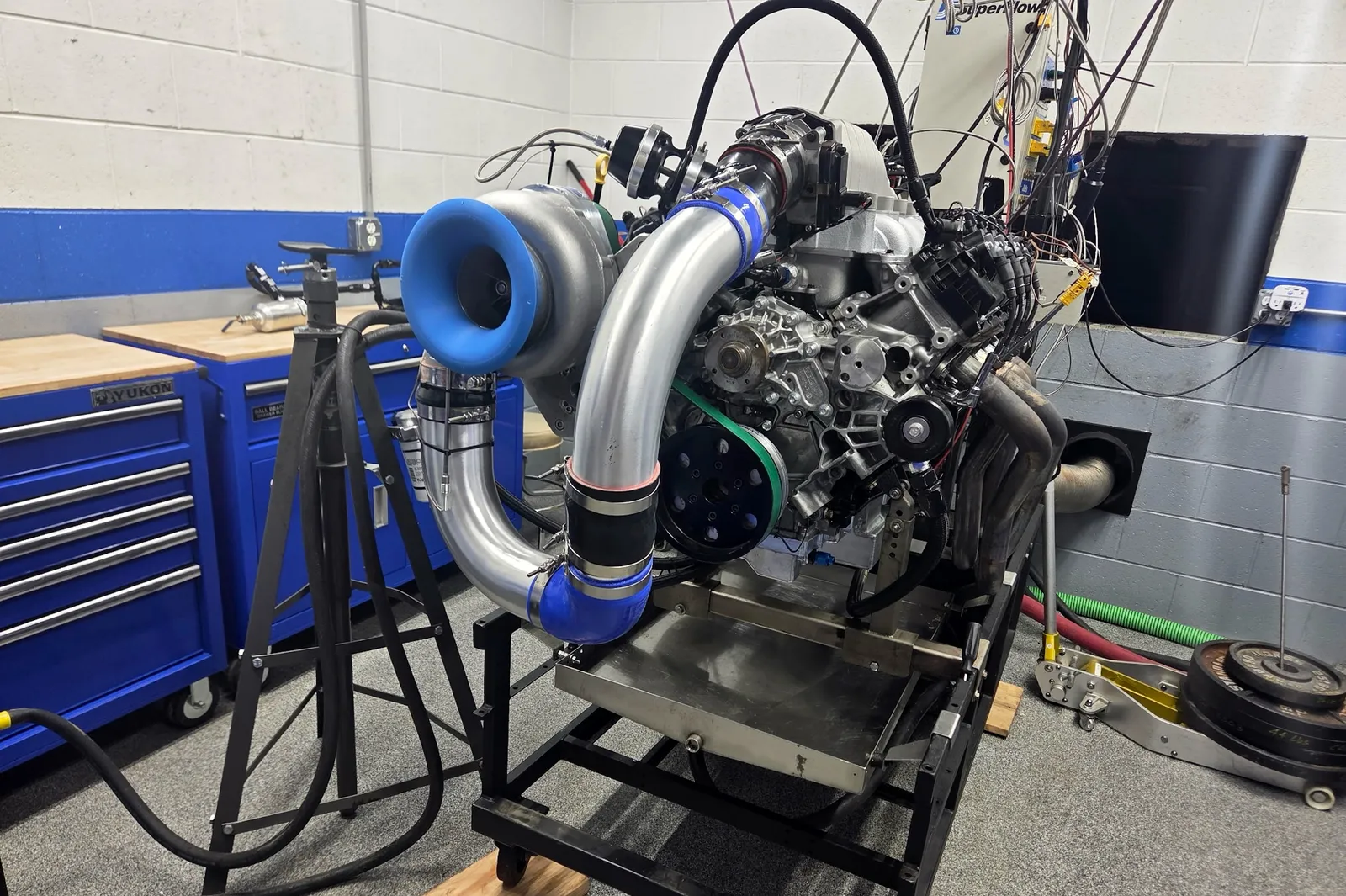
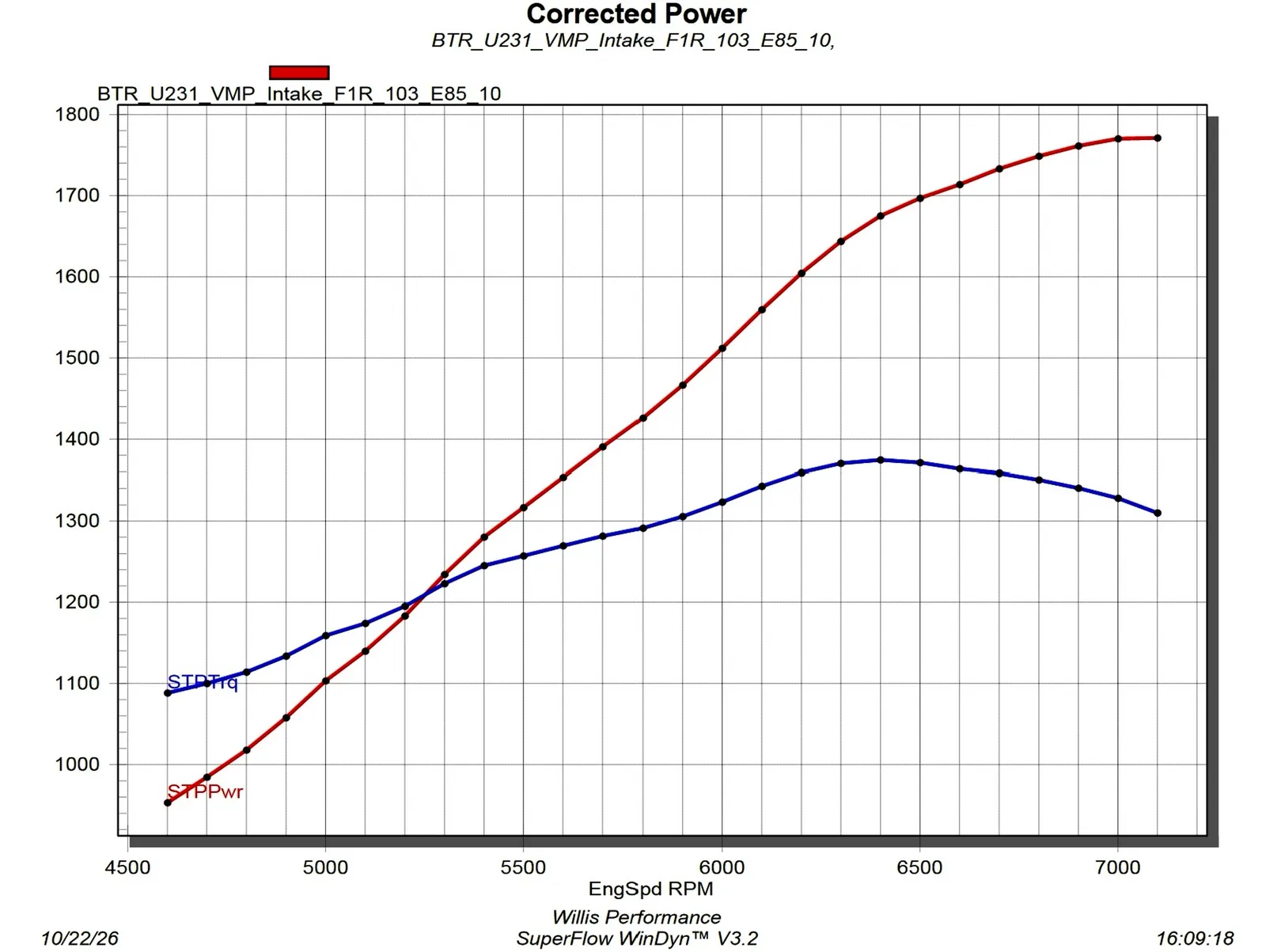
Ford's 7.3-liter Godzilla started life as a work-truck engine with a cast-iron block and a single cam in the valley. On Brian Wolfe's engine dyno, with a stock block, stock crankshaft and factory head castings, it just made 1,771 hp at 7,100 rpm and 1,375 lb-ft at 6,400 rpm. FordMuscle's Steve Turner reported the test on Oct. 30, and the part that made it possible is VMP Performance's new Leviathan air-to-water intercooled intake.
TORQFOLIO did not run this test. This is a read of FordMuscle's report. It is one engine on one dyno, so treat it as a well-documented data point rather than a consensus.
What the Leviathan is
 View full photo
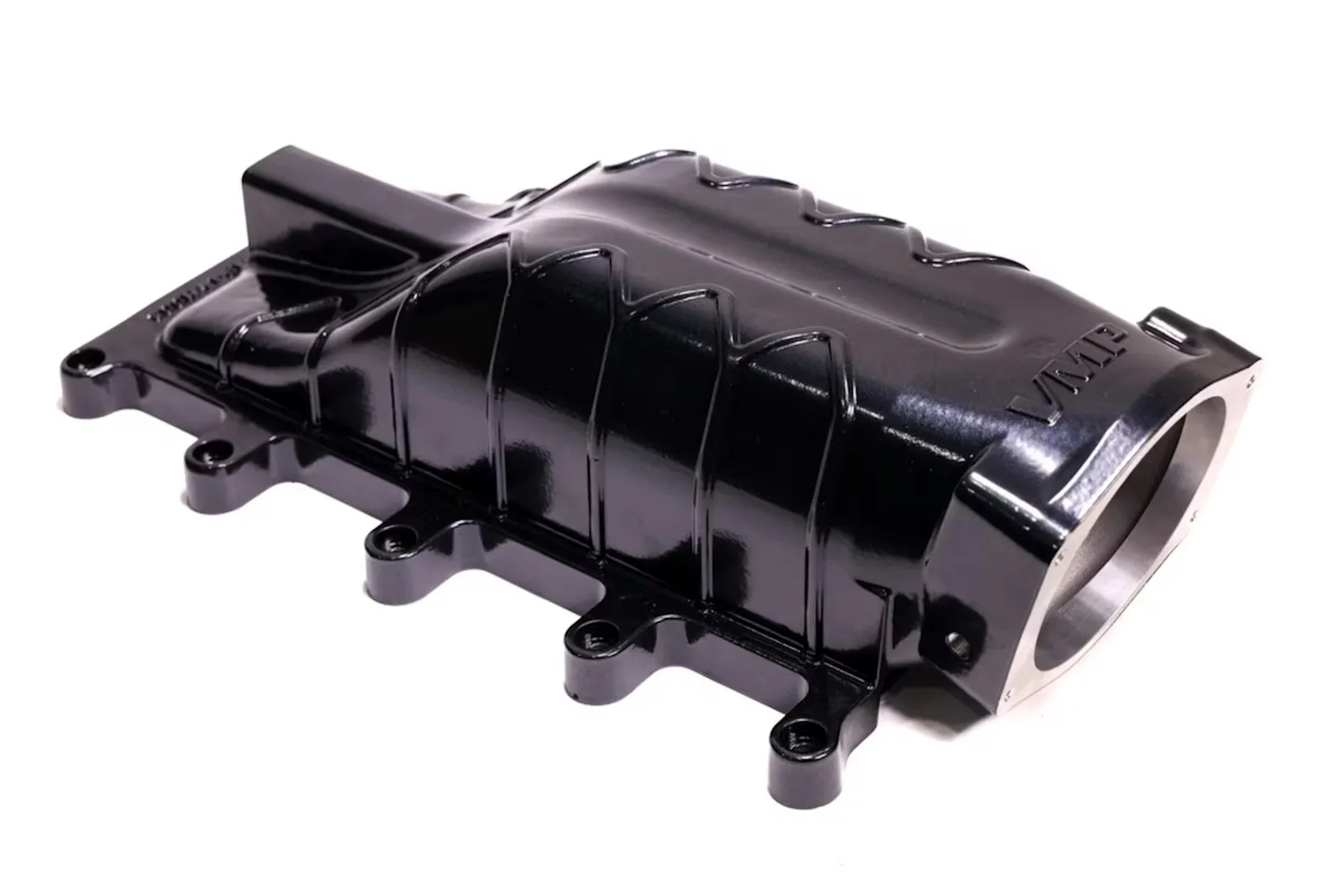
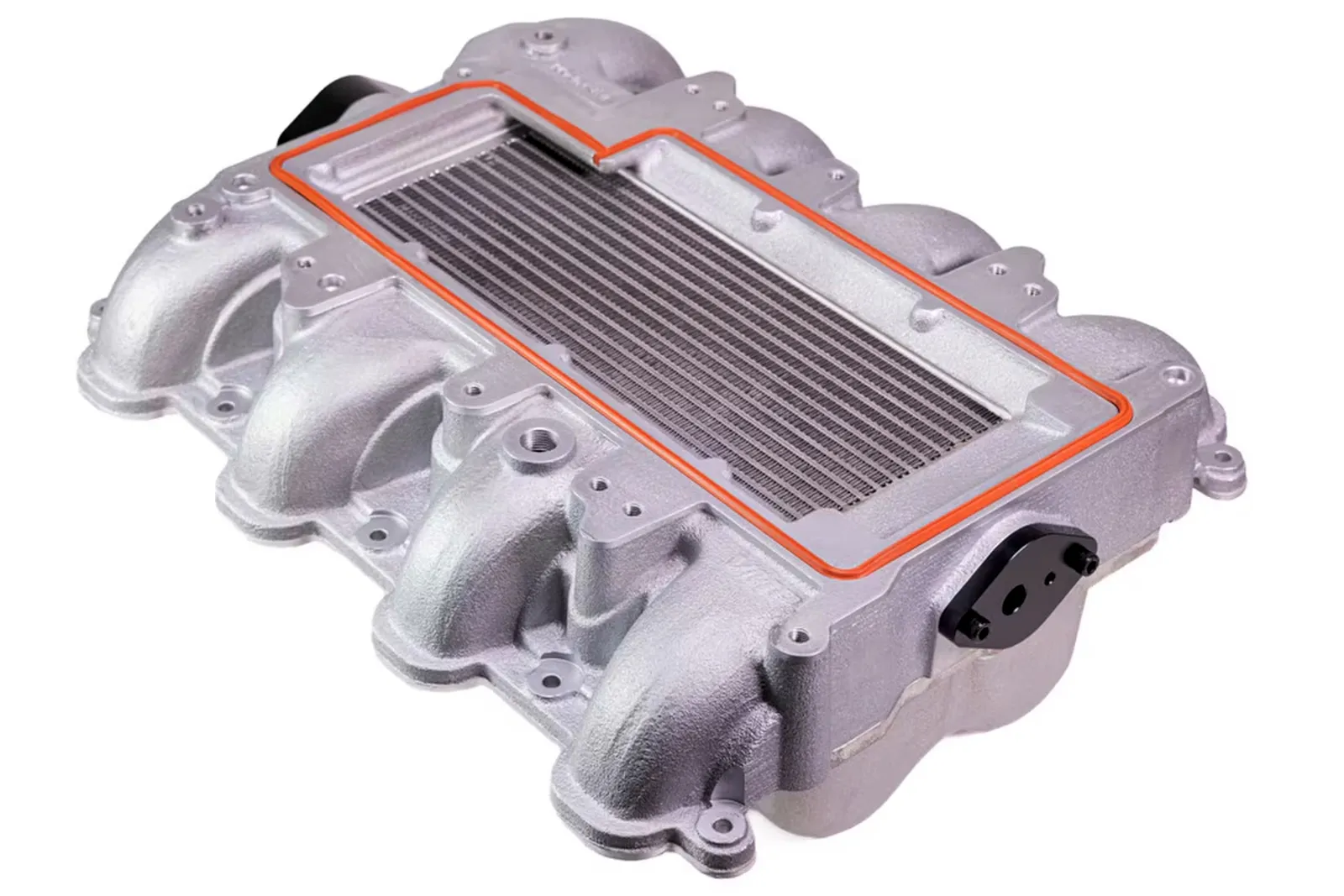
It is a two-piece induction system for boosted Godzilla engines, built around an air-to-water intercooler that sits in the intake. The turbo hat, part number VMP-LVN100, is $799.99 in bare aluminum, with gloss black available and billet and low-profile versions planned. The lower intake manifold with the intercooler, VMP-LVN330, is $2,399.99 and uses -20 ORB fittings for the coolant plumbing. VMP also plans a pump, reservoir and heat exchanger kit for under $1,000 for people who do not want to run ice.
The pitch is simple. Centrifugal blowers spinning hard heat the air, hot air costs power and invites detonation, and an air-to-water core can pull that heat out right before the air reaches the ports. VMP founder Justin Starkey put it in one line to FordMuscle: "Air to water keeps temps under control, which keeps tuners happy."
The test engine
 View full photo
Wolfe, who FordMuscle notes is a retired Ford Director of Global Engine Engineering, built the mule at Willis Performance Enterprises. The block, crank, head castings, head gaskets, oil pump, cam drive and rocker arms are stock. The heads are ported with 2.220-inch titanium intake valves and 1.700-inch stainless exhaust valves, and the valvetrain uses 10K Technologies springs, Manton 3/8-inch pushrods, Johnson short-travel lifters and a Brian Tooley Racing U231 cam. Forged pistons and rods set compression at 10.1:1. Fueling is Injector Dynamics 1,750cc injectors with an OBR ECU, and air comes through a 95mm throttle body.
The blower is a ProCharger F-1R-103 on a 4-inch supercharger pulley and 8-inch crank pulley, a 10.8:1 overall drive ratio. FordMuscle calculates that at 7,000 engine rpm, with no belt slip, the blower would be turning about 75,600 rpm. That is a lot of heat to manage.
The results
 View full photo
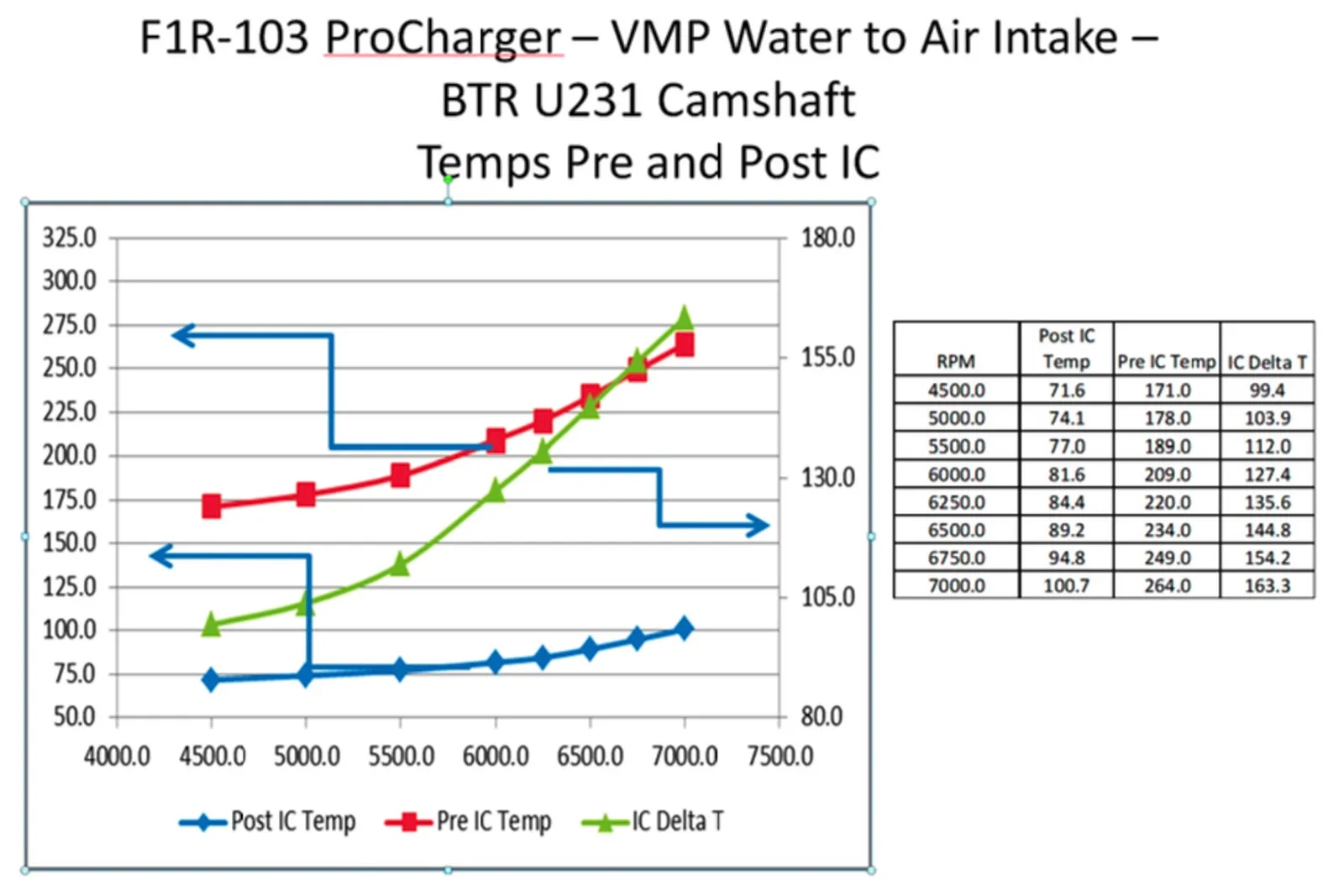
The power is the headline, but the temperatures are the story. At 7,000 rpm, intake air temperature measured about 270 F before the intercooler and about 100 F after it, a drop of roughly 170 degrees. The cost in pressure was small: at 6,500 rpm, boost read about 30 psi before the core and 29 psi after. The intercooler water started each pull at 40 F.
The test was run carefully. FordMuscle reports the E85 was verified at 85 to 90 percent ethanol, ignition timing was conservative, commanded lambda was 0.82, and the data was corrected with SAE J607. One honest limitation: the Ford Nano TMAP sensor used to log boost is a 3-bar absolute unit, and FordMuscle says it could not accurately record boost at peak power.
Read the comparison carefully
 View full photo
Wolfe's own comparison is the one to take seriously. "The results were great in my opinion; it picked up 40 horsepower over the air-to-air intercooler we tested with an F-1A-94," he told FordMuscle. Note the catch he points out himself: he did not test the bigger F-1R-103 with the air-to-air setup, so that 40-hp figure compares the intake systems on different setups. FordMuscle also reports the new combination made about 200 hp more than the earlier F-1A-94 reference, but that number compares different superchargers, not just the intercoolers.
FordMuscle also warns that results like these will not necessarily carry over to other engines or to street cars, since blower choice, fuel, calibration and intercooler conditions all change the outcome. Wolfe's next round moves to larger crank-driven ProChargers on race fuel, still with the VMP intake.
What we would want to see next
This test answers the big question, whether the core can handle the heat a hard-spun centrifugal blower makes, but it leaves a few for street builders. The intercooler water started each pull at 40 F, which is ice-water territory, and VMP's own planned pump and heat exchanger kit is the setup most owners will actually run. A test on that kit, over back-to-back pulls where the water heats up, would show how much of the 170-degree drop survives heat soak. A same-blower comparison against an air-to-air system would also put a cleaner number on what the Leviathan itself is worth. Wolfe's next round, on bigger crank-driven ProChargers, should at least show whether the core keeps up as the airflow climbs.
TORQFOLIO's read
For a single test, this one is well documented: known parts, verified fuel, a stated correction standard and a sensor limitation disclosed instead of hidden. The data points to the Leviathan doing what an air-to-water intake is supposed to do, pulling well over 100 degrees out of a hard-working centrifugal charge with about 1 psi of pressure loss.
Who is it for? Anyone building a boosted Godzilla for the strip, a swap or a serious Super Duty, especially with a centrifugal blower where charge heat is the limit. Budget about $3,200 for the hat and manifold, plus cooling hardware, and expect your tuner to like you. Starkey's take after seeing the numbers was "I'm blown away; it seems this is what Godzilla has needed all along." He sells the part, so wait for more tests before you take his word for it. On this test, though, the numbers back him up.
Sources
This story is compiled from the published sources listed below.

Written by
Devin B.
Founder
Devin founded TORQFOLIO to cover the whole aftermarket scene, from hot rods and LS swaps to donks, drift and Baja. Based in Las Vegas and usually at a show or meet with a camera.
More from Devin B.TORQFOLIO Weekly
The best of the week in cars, builds & culture. Every Sunday.
Keep Reading
Ten-Second Slips at Sonoma: What the Testers Found in the 795-HP Mustang Dark Horse SC
Devin B.,
Six Cylinders, Two Turbos, One Problem: What a Week in the Charger Sixpack Taught Motor1 and The Drive
Devin B.,
SEMA 2026 From the Floor: A 1,300-HP Chevelle Champion, Desert-Ready Factory Rigs and the Builds Worth Finding
Devin B.,
SEMA 2026 Factory Builds: Jeep Ditches the Solid Axle, Ford Brings a 1,200-Plus-HP Bronco
Devin B.,
Conversation 0 comments
No comments yet. Start the conversation.